Walk-In Wine Cooler Guide for Home Cellars

*Pictures are renderings. Actual wine racks may look different
A walk in wine cooler for home starts with the room, not the racks. The right choice depends on the space you have, how you want to store and display your collection, and whether a dedicated cellar suits your home better than a wine refrigerator.
A successful cellar brings together room design, insulation, cooling, doors, and racking as one system. Each decision affects the construction plan, the cooling approach, and the way the finished space looks and functions. Thinking about these elements together helps you avoid choosing equipment or racks before you understand the room they need to serve.
This guide compares room-scale wine storage with an appliance and explains the construction and design choices that shape a home cellar. Whether you are considering a compact space or a glass-enclosed feature, you will find practical starting points for planning a design around your home and collection.
Key Takeaways
- Compare a walk-in cellar with a freestanding or built-in wine refrigerator to decide which format suits your space and storage goals.
- Plan insulation, walls, doors, and cooling as connected parts of the room rather than treating the cooling unit as a standalone choice.
- Choose between a walk in wine cooler for home and an appliance by considering room commitment, design integration, and how you want to display your collection.
- Start with the room and your collection goals, then plan racking, lighting, doors, and finishes around them.
- Use a free 2-D design service to turn your cellar vision into a practical layout.
What Does a Walk-In Wine Cooler for Home Include?
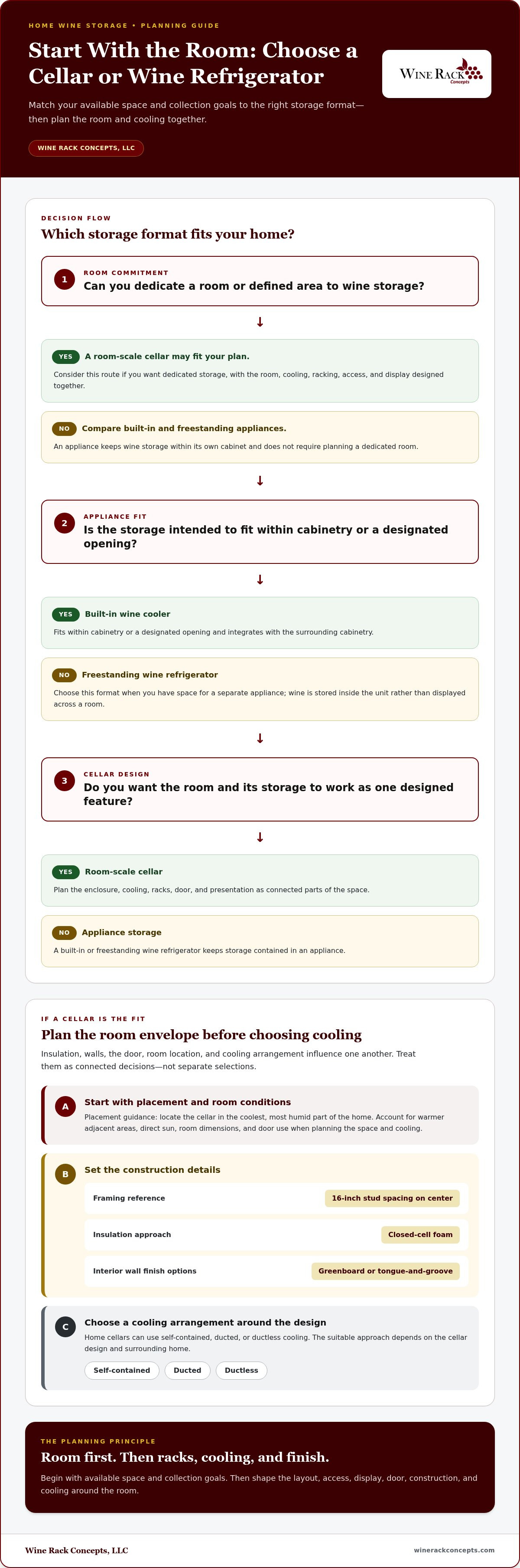
A walk-in wine cooler is a room designed for wine storage, with its enclosure, cooling, racking, access, and display planned together. A freestanding or built-in wine refrigerator is an appliance that stores wine within its own cabinet. The distinction affects the project's scope and how the storage fits into your home.
A room-scale cellar brings together the room envelope, cooling approach, racks, and door. The wine cellar overview provides general context on storage conditions, including temperature and humidity. For a home project, the layout and construction choices should account for the room and how you want to access and present your collection.
The right format depends on available space, collection goals, and the presentation you want. A dedicated room can become a visible design feature, while an appliance may suit a home where a separate cellar is not practical. Wine Rack Concepts designs custom residential cellars as well as wine storage solutions for spaces that call for a rack system.
How Is a Walk-In Wine Cooler Different From a Wine Fridge?
A walk-in cellar is a room-scale project, not simply a larger refrigerator. Its walls, door, cooling, and racking work together as an enclosure, with the layout shaped by the room. A wine refrigerator keeps storage within an appliance, so it does not require planning a dedicated room. For a custom residential cellar, Wine Rack Concepts brings the room and its storage elements into one design plan.
Who Benefits From a Walk-In Home Wine Cellar?
A walk-in may suit collectors who want dedicated storage and a considered display, or homeowners planning around an existing room or renovation. The project can be tailored to the available space, preferred style, and budget, whether the cellar is intended to feel discreet or make the collection part of the home's visual character.
| Format | Room commitment | Design integration | Cooling and presentation |
|---|---|---|---|
| Room-scale cellar | Uses a dedicated room or defined area. | Can be designed as part of the home. | Cooling and racking are planned for the space; display is shaped by the layout. |
| Built-in wine cooler | Fits within cabinetry or a designated opening. | Integrates with surrounding cabinetry. | Storage and cooling are contained in an appliance. |
| Freestanding wine refrigerator | Needs space for the appliance. | Can be placed as a separate unit. | Wine is stored inside the appliance rather than displayed across a room. |
Think of the choice as a match between your home and your collection. If you want a dedicated destination with coordinated racks, cooling, and finishes, a room-scale cellar gives you more elements to shape. If you need contained storage instead, a built-in or freestanding appliance offers a different fit. Plan a walk in wine cooler for home as a complete space so storage and presentation work together from the outset.
How Room Construction and Climate Control Work Together
A cooling unit cannot compensate for a room that allows too much heat or moisture to move through its boundaries. In a walk in wine cooler for home, insulation, walls, the door, room location, and cooling arrangement all influence the conditions the system must maintain. Plan these elements together, rather than choosing equipment before you understand the room.
Effective cellar planning treats the room envelope and cooling as connected decisions. The room envelope includes the surfaces that enclose the cellar, such as its walls and door. If the cellar is beside a warmer area or receives direct sun, account for those conditions along with the room's dimensions. Wine Rack Concepts' placement guidance is to locate a cellar in the coolest, most humid part of the home, then coordinate construction and cooling choices around that location.
Which Construction Choices Shape a Climate-Controlled Cellar?
Construction guidance calls for framing with standard 16-inch stud spacing on center, followed by closed-cell foam insulation. Greenboard or tongue-and-groove walls are interior finish options. These choices establish the room where the cooling system will operate, so include them in the plan before settling the cellar layout and equipment.
Each detail affects how the room comes together. Stud spacing provides a framing reference, closed-cell foam is the specified insulation approach, and the wall finish contributes to the cellar's appearance. Greenboard offers one finish option, while tongue-and-groove creates a wood-lined look. The right choice depends on the style you want and how the room fits into your home.
Room placement is part of the same conversation. A cellar in a naturally cooler, more humid area starts from a different setting than one on a warm, sun-exposed wall. The room's dimensions, insulation, sun exposure, and door use also help inform cooling selection. That is why construction and equipment should not be treated as separate decisions or finalized in isolation.
What Cooling Arrangements Can a Home Cellar Use?
Home cellars can use self-contained, ducted, or ductless cooling arrangements. The right approach depends on the cellar design and the surrounding home, so consider the room before selecting equipment. Wine Rack Concepts offers wine cellar cooling systems as part of its climate-control solutions.
For example, a room incorporated into an existing part of the home may present different placement considerations from a cellar planned alongside a renovation. In either case, dimensions, insulation, location, and door use help frame the cooling decision. Bringing those details into the design process keeps the room's construction and climate requirements aligned.
Once you have identified a possible location and construction approach, a layout can bring those decisions into clearer view. Wine Rack Concepts offers a free 2-D cellar design service to help translate your room and storage goals into a coordinated plan.
Compare Walk-In Wine Cellar Options Before You Choose
Choosing a storage format starts with a practical question: do you want a room designed around your collection, or an appliance that stores wine within its own enclosure? A dedicated cellar can bring climate control, racking, doors, and finishes together as one home feature. A wine cabinet or refrigerator keeps the project more contained. Compare how each option fits your available space and the role you want wine storage to play in your home.
| Format | Room commitment | Home design integration | Cooling approach | Storage presentation |
|---|---|---|---|---|
| Dedicated custom cellar | Requires a room or defined area planned for wine storage. | Can be coordinated with the home's layout and finishes. | A cooling system is selected as part of the room plan. | Racking, doors, and finishes can create a dedicated display. |
| Wine cabinet | Uses a defined area for a cabinet rather than a dedicated room. | Can be chosen to suit the space where it will sit. | Cooling is contained within the cabinet format. | Wine is presented within the cabinet. |
| Standard wine refrigerator | Needs space for an appliance. | Works as a separate unit or within a planned opening, depending on the format. | Cooling is part of the refrigerator appliance. | Wine is stored and viewed inside the unit. |
When Does a Dedicated Walk-In Cellar Make Sense?
A dedicated cellar may be the right direction if you want wine storage to feel like a considered part of the home, rather than an appliance placed within it. It can be planned around an existing room, a defined area, or a renovation. A custom project also lets you coordinate racking, doors, finishes, and cooling within one design, adapting the plan to the available space and your preferred style. The layout depends on the room and your priorities, not a one-size-fits-all footprint or capacity.
When Might a Wine Refrigerator Be the Better Fit?
A wine refrigerator may suit homeowners who want appliance-style storage and are not planning a dedicated room. It offers a contained approach without designing an enclosure around the collection. By contrast, custom cellar planning considers room construction and coordinated design, from the enclosure and cooling to the racking and finishes.
The best format follows your available space and storage priorities. If you want a walk in wine cooler for home that brings the cellar environment and its presentation together, a dedicated room offers more design elements to consider. If your priority is contained storage, a cabinet or refrigerator may better match the project's scope. Think about where the wine will live, how visible you want the collection to be, and whether the room itself is part of your vision.
If a dedicated cellar seems like the right direction, a free 2-D design can help turn your initial ideas into a layout. Explore a cellar design as a next step in shaping a plan for your home and collection.
Plan Your Home Wine Cellar Around Space, Racking, and Finish
A strong cellar plan begins with the room, then makes room for the collection and the details that give the space character. Separate fixed conditions, such as the room's dimensions, from choices you can shape, including racking layout, door style, lighting, and finishes. That distinction helps keep a walk in wine cooler for home practical as well as visually cohesive.
- Choose the room. Note its location and measure the usable width, depth, and height. Record fixed features that affect the plan, including door openings and walls that cannot move.
- Define collection goals. Consider what kinds of wine you store, how you want to access it, and whether the collection should be visible from an adjoining room. Focus on storage and display priorities rather than assuming a particular bottle count.
- Plan access and presentation. Decide where the cellar door belongs and how people will move through the space. Include lighting in the design brief so it can be coordinated with the racks and overall presentation.
- Select racking and finishes. Choose the rack material and layout, then consider wall finishes and how they work alongside the door and lighting.
These steps help distinguish what the room dictates from what the design can adapt. The available dimensions are a starting constraint; the arrangement of racks, choice of materials, and visual balance can be tailored to the space. A coordinated custom wine cellar design brings those decisions together instead of treating each element as a separate choice.
What Should You Decide Before Designing the Room?
Begin with location, measurements, and your collection's storage and display priorities. Then note access needs, preferred door style, lighting, and wall finishes. A clear brief gives the design a useful foundation and distinguishes fixed dimensions from adjustable elements, so the plan can focus on choices that shape the room without assuming a particular capacity.
Racking options include wood, metal, and acrylic. Wood racks can be stained or lacquered, and finish choices can be considered alongside the room's materials and visual style. The rack layout influences how wine is arranged and displayed, while the chosen material helps establish the cellar's character. A contemporary metal or acrylic look and a traditional wood presence create different design directions; the right one depends on your home and collection.
How Can Racking and Finishes Shape the Cellar?
Think of racking as both storage infrastructure and a visible design element. Its placement affects how the available walls are used and how the collection appears from the doorway. Coordinating rack material with wall finish, door, and lighting creates a more intentional result. Wine Rack Concepts offers wood, metal, and acrylic racking, with series and styles to suit different cellar designs.
Rack dimensions can help you assess how a system may fit the room. The Wall Wine Rack Series is 12" deep, the Classic Series is 12 ¼" deep, the Carpenter Series is 13 ¼" deep, and the Vintner Series is 13 ½" deep. The website's price tiers are $, $, $$, and $$ for those series, respectively. Use these details as part of comparing rack options, then consider how each layout works with doors, access, and the available wall space.
Project costs depend on the scope of framing, insulation, doors, lighting, cooling, labor, and racking selection. Wine cellar projects can be under $10,000, up to $500,000, or anywhere in between, depending on design choices. A defined plan makes these components easier to consider together while leaving adjustable design choices open for refinement.
Bring Your Walk-In Wine Cooler for Home From Plan to Design
A clear plan turns a cellar idea into a set of design decisions that can be considered together. Wine Rack Concepts designs custom residential cellars, wine racks, and climate-controlled builds. With decades of experience creating American wine racks, the company develops customizable projects for different spaces, styles, and budgets. Its range of materials and components lets you shape a cellar around the needs of your project.
What Can a Custom Wine Cellar Project Bring Together?
A project can range from a racking system to a complete climate-controlled cellar build. In a room-scale design, racks, cooling, doors, glass enclosures, and interior finishes can be coordinated so the storage plan and the room's appearance feel connected. For example, a glass enclosure can make the collection visible, while the racking and finishes help the cellar relate to the surrounding interior.
Coordination also keeps the project grounded in the home's actual space. The available room, preferred style, and storage goals guide the design, rather than requiring you to begin with a preset layout. A walk in wine cooler for home can be planned as a distinctive display or a more understated storage room, with the details tailored to your vision.
How Do You Start a Free 2-D Wine Cellar Design?
Begin by gathering information that communicates your idea. Room dimensions establish the available space, while inspiration images and preferred materials clarify the look you have in mind. Storage goals and display priorities show how you want the room to function. An early concept is useful even if some decisions are still taking shape.
Useful details to share include:
- Room measurements and the location of doors or other fixed features.
- How you want the collection stored and presented.
- Preferred racking materials, such as wood, metal, or acrylic.
- Ideas for doors, glass, and finishes that suit the home.
The free 2-D design service helps translate those details into a considered cellar plan. It gives the project a visual starting point for bringing room layout, racking, and climate control into one design conversation. With your goals on paper, submit your project vision and begin shaping a cellar around your home and collection.
Give Your Cellar Vision a Clear Starting Point
A walk in wine cooler for home can become more than a place to keep a collection. It can reflect the way you enjoy wine and the character of your home. You do not need every design decision settled before moving forward. A first concept gives you something tangible to review and refine around what matters most.
Wine Rack Concepts works with homeowners to develop custom cellar designs, from racking systems to complete climate-controlled builds. Its free 2-D design service offers a practical starting point for turning an idea into a considered plan.
Take the next step and put your cellar concept on paper.
Your collection deserves a space that feels distinctly yours. Start with the idea, then shape the design around your home and storage goals.
Frequently Asked Questions
Can a walk-in wine cooler be installed in an existing room?
Yes, an existing room can be the starting point for a walk in wine cooler for home. Begin by recording its dimensions, location, usable wall lengths, and existing openings. Also consider how the door will affect movement into the room. These details help shape the cellar plan around the space instead of assuming the room is ready for cooling as-is.
Does a home wine cellar need insulation?
Yes, insulation is part of the cellar construction guidance. Closed-cell foam is the specified insulation approach, with greenboard or tongue-and-groove walls as interior finish options. Include insulation in the room plan before finalizing cooling choices, since the enclosure and cooling system need to be considered together. For an existing room, note its current wall conditions in the early design brief.
What kind of door can a walk-in wine cellar have?
A walk-in cellar can have an exterior-grade door made of wood, fiberglass, glass, or metal. The choice affects how the entrance relates to the cellar and surrounding interior. Glass can preserve a view into the room, while wood or metal can create a more defined visual boundary. Consider the door's position and the connection you want between the cellar and adjacent spaces.
Can a walk-in wine cellar have a glass enclosure?
Yes, a glass enclosure can make the cellar and its racking visible as part of the home's design. Before choosing this approach, consider which views into the room matter most, such as the sightline from a dining area or living space. Plan the enclosure, entry, and racks to present the collection clearly while keeping access practical.
What lighting can be used in a home wine cellar?
IC can lights are an option if recessed can lighting is used. Consider lighting while planning the rack arrangement, so the intended display and the room's overall appearance are addressed together. Decide which areas should be visually prominent and where people will enter or move through the cellar. The lighting plan can then support those priorities instead of being treated as an afterthought.
Can a wine cellar be designed for both storage and display?
Yes, a cellar can be planned to store wine and present the collection as part of the room. The balance depends on how visible you want the racks to be and how you expect to use the space. You might make the collection a focal point near the entrance or keep the display more understated. Racking material, layout, and room finishes all help establish that character.
What should I share when requesting a free wine cellar design?
Share the room dimensions, any inspiration images or ideas, your storage and display goals, and preferred materials. You can mention whether wood, metal, or acrylic racking appeals to you, along with ideas for the room's finishes and door. If some choices are still open, describe what you know so far. These details give the design process a helpful starting point for shaping a cellar around your home.

Have an expert help today!
Free 2D wine cellar design